Hydrocele vs Varicocele: The Complete Guide to Symptoms, Causes, Fertility Impact, and Natural Treatment
A research-backed breakdown of two commonly confused scrotal conditions, what separates them, what they mean for your fertility, and how natural treatment supports both without surgery.
A strange swelling, heaviness, or lump around the scrotum is one of the most alarming things a man can discover about his own body, and it’s also one of the most googled. Two conditions dominate that search: hydrocele and varicocele. They sit in the same part of the body; they can both cause discomfort, and they are frequently mixed up, even by men who have already seen a doctor.
But a hydrocele and a varicocele are fundamentally different problems with different causes, different fertility implications, and different paths to relief. This guide breaks down hydrocele vs varicocele in plain language, backed by clinical research, so you know exactly what you’re dealing with and what your options are, including natural approaches that support the body’s own repair and circulation processes rather than jumping straight to a scalpel.
If you already know which condition you’re dealing with, go straight to our varicocele support page for a deeper breakdown of natural correction options.
What Is a Hydrocele, and What Is a Varicocele?
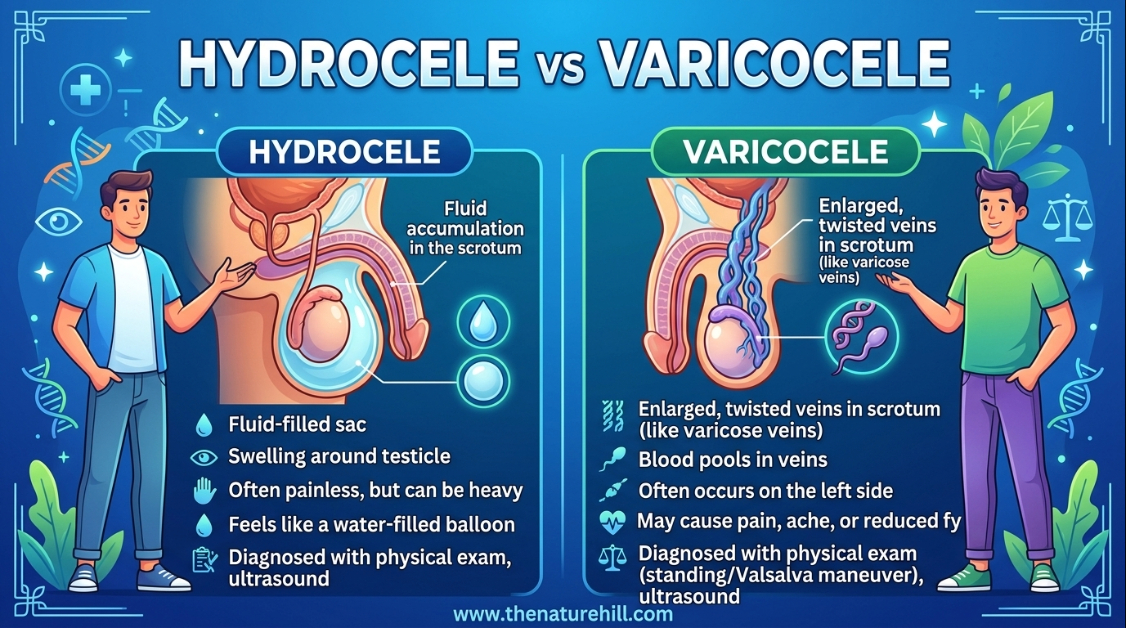
A hydrocele is a fluid problem, not a vein problem. It happens when serous fluid collects in the tunica vaginalis, the thin sac that surrounds the testicle, causing that side of the scrotum to swell like a small water balloon. In babies, this is usually because the processus vaginalis hasn’t fully closed after birth. In adult men, it can follow an injury, an infection such as epididymitis or orchitis, surgery in the groin, or occur for no identifiable reason at all.
A varicocele is a vascular condition. It develops when the veins of the pampiniform plexus, the network draining blood from the testicle, become enlarged and twisted because their one-way valves weaken, allowing blood to pool rather than drain. This is the same underlying mechanism as a varicose vein in the leg, occurring inside the scrotum instead, and is famously described as feeling like a “bag of worms.” Varicocele affects approximately 15% of all men and as many as 35 to 80% of men being investigated for infertility, making it the single most common identifiable and correctable cause of male factor infertility worldwide.
Hydrocele vs Varicocele: Key Differences at a Glance
| Feature | Hydrocele | Varicocele |
|---|---|---|
| What it is | Fluid buildup around the testicle | Enlarged, twisted veins (pampiniform plexus) |
| Feel | Smooth, tense, fluid-filled | Soft, lumpy, “bag of worms” |
| Common side | Either side | Usually left (85–90%) |
| Lying down | Stays roughly the same size | Shrinks or disappears |
| Transillumination | Glows | Does not glow |
| Pain | Usually painless | Dull ache, worse standing |
| Fertility impact | Usually none | Well established link |
| First-line approach | Observation or natural support | Natural circulatory support |
Symptoms Comparison: How to Tell Them Apart
Self-diagnosis should never replace a proper medical exam, but knowing what to look for helps you describe your symptoms accurately and get faster answers.
A hydrocele surrounds the testicle almost like a balloon of water, which can make it hard to feel the testicle itself clearly. A varicocele leaves the testicle easy to feel normally, with the dilated veins felt separately, just above or behind it.
Varicoceles typically shrink noticeably, or disappear entirely, when you lie flat, because gravity stops pulling blood into the pooled veins. A hydrocele’s size stays roughly constant regardless of position.
Both conditions can cause a dull, dragging ache after long standing, heavy lifting, or sexual activity. Hydroceles are more often painless; varicocele discomfort tends to build across the day and ease when lying down.
In a clinical setting, doctors use transillumination, shining a penlight against the scrotum in a dark room. Fluid transmits light and glows; blood-filled, tissue-dense varicocele veins do not.
What Causes Hydrocele and Varicocele?
- Processus vaginalis not fully closing (infants)
- Direct injury or trauma to the scrotum
- Infections such as epididymitis or orchitis
- Inflammation following groin surgery
- Underlying hernia, or rarely a tumor to rule out
- Venous valve failure in the pampiniform plexus
- Anatomical disadvantage of the left testicular vein
- Prolonged standing occupations
- Heavy lifting or chronic straining
- Age-related weakening of vein valves
Hydrocele vs Varicocele: Which Affects Fertility?
This is the question most men actually want answered, and the research here is fairly clear-cut. Varicocele is the single most commonly identified correctable cause of male infertility. A varicocele is found in about 15% of otherwise healthy men, but that number climbs to roughly 35% among men with primary infertility, and as high as 70–80% among men with secondary infertility, where a man previously fathered a child but is now struggling to conceive again.
The proposed mechanism isn’t just “bad veins.” Research points to oxidative stress and elevated testicular temperature as the key pathways through which varicocele damages sperm production, since pooled blood raises the local temperature around the testicle above the level sperm-producing tissue tolerates. Over time, this can lower sperm count, reduce motility, and increase the proportion of abnormally shaped sperm.
Hydrocele’s relationship with fertility is much less established. It generally does not damage the testicle directly, and small to moderate hydroceles are considered fertility-neutral. However, some research has explored whether large, long-standing hydroceles could contribute to a similar thermal-stress question, since a fluid-filled sac sitting around the testicle for an extended period may interfere with the body’s natural cooling mechanism. Read more in our post on varicocele and infertility.
CAN YOU HAVE BOTH AT THE SAME TIME?
Yes, and it’s more common than most men expect. Because both conditions occur in the same anatomical space, a hydrocele can develop on one side while a varicocele is present, either on the same side or the opposite one. This is one of the biggest reasons self-diagnosis isn’t reliable and a proper ultrasound is often needed.
Hydrocele vs Varicocele vs Epididymal Cyst, Spermatocele and Hernia
A few other conditions get lumped into the same mental bucket, so it’s worth a quick distinction:
- Epididymal cyst / spermatocele: a small, usually painless, fluid-filled sac on the epididymis rather than around the testicle. Transilluminates but is typically smaller and separate on exam.
- Inguinal hernia: tissue pushing through a weak spot in the abdominal wall. Often bulges more with coughing or straining and can sometimes be pushed back in.
- Epididymitis: inflammation of the epididymis, usually infection-driven, causing pain, swelling, and sometimes fever. Often needs antibiotics urgently.
- Testicular torsion: a medical emergency, twisting of the spermatic cord cutting off blood supply. Sudden severe pain, needs immediate medical attention.
How Are They Diagnosed?
Physical exam. Examined standing and lying down, feeling for texture, position change, and tenderness.
Transillumination. A penlight in a darkened room. Fluid glows; solid tissue and pooled blood do not.
Scrotal ultrasound with Doppler. The gold standard: confirms diagnosis, measures vein reflux in suspected varicocele, and rules out more serious causes.
Treatment Options: Surgery vs Natural Support
Conventional medicine’s default answer for both conditions, once symptomatic, tends to be surgery: hydrocelectomy for hydrocele, and varicocelectomy or embolization for varicocele. But surgery is not the only responsible option. Both conditions have circulatory, inflammatory, and hormonal components that respond to targeted natural support, especially when caught early or symptoms are mild to moderate.
The Nature Hill
VaricoBoost — Natural Support for Varicocele
Because varicocele is fundamentally a vein and circulation problem, it responds well to botanicals long used for varicose veins, supporting vein tone, circulation, and testicular temperature regulation. Read our detailed guide on varicocele treatment without surgery.
The Nature Hill
Hydrocele Kit — Natural Support for Hydrocele
Hydrocele responds well to a different angle of support, focused on reducing inflammation, supporting healthy fluid balance, and encouraging the body’s natural reabsorption processes rather than mechanically draining fluid that often just returns. Read our full guide on hydrocele treatment without surgery in adults.
View Hydrocele Kit →Supporting Overall Reproductive Health
Sperm quality, hormonal balance, and prostate health are all connected systems. Depending on your situation, one or more of these may pair well alongside varicocele or hydrocele support. Contact us at [email protected] for a personalised recommendation.
Natural sperm count, motility, and morphology support for men actively trying to conceive.
View SpermBoost →Natural prostate support formula for men over 40, especially useful alongside a scrotal condition.
View ProstaTreat →When to See a Doctor Urgently
Natural support is a legitimate and often effective first step, but certain symptoms should never wait for a herbal protocol to work.
- Sudden, severe testicular pain
- Rapid swelling within hours
- Fever combined with scrotal pain or swelling
- A hard, irregular lump that doesn’t fit the smooth or “bag of worms” description
- Nausea or vomiting alongside testicular pain
Frequently Asked Questions
Final Thoughts
Hydrocele and varicocele get confused constantly, but once you understand what’s actually happening inside the scrotum, the difference is straightforward: one is a fluid problem, the other is a vein problem, and only one of them carries a strong, research-backed link to fertility. Neither diagnosis has to mean an automatic trip to the operating table.
With the right natural protocol, targeted at the actual mechanism at play, many men find real, lasting relief without surgery. If you have questions about your specific case, The Nature Hill’s wellness team offers free consultations via WhatsApp before you commit to any protocol.
Not Sure Which Condition You’re Dealing With?
Reach out for a free consultation and we’ll help you identify the right natural protocol for your specific case.
More From The Nature Hill
- Varicocele and Infertility — What the Research Shows
- Varicocele Treatment Without Surgery: The Complete Natural & Herbal Guide
- Hydrocele Treatment Without Surgery in Adults
- SpermBoost — Natural Sperm Count, Motility and Morphology Support
- ProstaTreat — Natural Prostate Health Capsules for Men Over 40
Disclaimer: This article is for informational and educational purposes only and does not constitute medical advice. VaricoBoost and the Hydrocele Kit are natural wellness supplements and are not intended to diagnose, treat, cure, or prevent any medical condition. Always consult a qualified healthcare professional before starting any supplement, particularly if you have an existing health condition or are taking prescription medication.

